# Reading potentiometer sensor value via an ADC HAL

## *Lab Objective:*

This lab demonstrates the process of reading a potentiometer sensor value through an Analog-to-Digital Converter (ADC) using a Hardware Abstraction Layer (HAL) on a PSoC 6 microcontroller.

## 🔥 Requirements

<table><thead><tr><th width="429">Resources</th><th>Links</th></tr></thead><tbody><tr><td>Computer</td><td>💻</td></tr><tr><td>ModusToolbox™ software v3.0 or later</td><td><a href="https://www.infineon.com/modustoolbox">Link</a></td></tr><tr><td>CY8CKIT-062S2-43012 Infineon Board</td><td><a href="https://github.com/Advance-Innovation-Centre-AIC/BIIL_MTB-100_Hello_World_and_LED_Blinking_Programming_Template/assets/88732241/0215501d-b774-4045-8e64-ef49e28d8404">Link</a></td></tr><tr><td>Technical Report</td><td><a href="https://www.dropbox.com/scl/fi/amaxc94pte0ut2i1r5ewx/Technical-Report-Lab00.paper?rlkey=b3xm3vrerz9xgv1glb30cvy9z&#x26;dl=0">dropbox</a></td></tr></tbody></table>

## 🚩 Let start

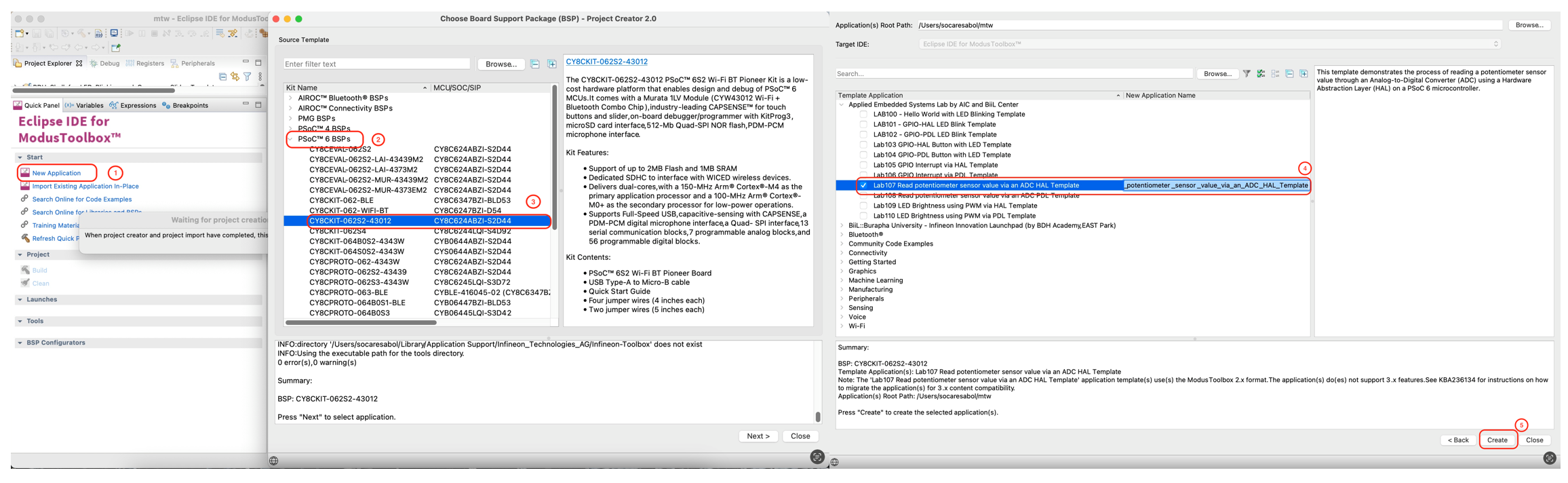
### Create Application&#x20;

<figure><img src="https://1856353139-files.gitbook.io/~/files/v0/b/gitbook-x-prod.appspot.com/o/spaces%2F-MClo3nC-1US0rbK8Qau%2Fuploads%2F9fPGim5XAT5fbNVhqu8a%2Fimage.png?alt=media&#x26;token=2f8c8d74-e89a-4b43-a4e2-61707c49ab17" alt=""><figcaption><p>Create Application</p></figcaption></figure>

### Coding

* Coding: Open the main.c file and add the following code to the main(void) function.

{% code title="main.c" %}

```c
#include "cy_pdl.h"
#include "cyhal.h"
#include "cybsp.h"
#include "cy_retarget_io.h"


int main(void)
{
    cy_rslt_t result;
	cyhal_adc_t adc_obj;
	cyhal_adc_channel_t adc_chan_0_obj;

    /* Initialize the device and board peripherals */
    result = cybsp_init() ;
    if (result != CY_RSLT_SUCCESS)
    {
        CY_ASSERT(0);
    }

    __enable_irq();

    /* Initialize retarget-io to use the debug UART port */
	result = cy_retarget_io_init(CYBSP_DEBUG_UART_TX, CYBSP_DEBUG_UART_RX, CY_RETARGET_IO_BAUDRATE);
	CY_ASSERT(result == CY_RSLT_SUCCESS);

	/* ADC conversion result. */
	int adc_out;

	/* Initialize ADC. The ADC block which can connect to pin 10[6] is selected */
	result = cyhal_adc_init(&adc_obj, P10_6, NULL);

	// ADC configuration structure
	const cyhal_adc_config_t ADCconfig ={
		.continuous_scanning = false,
		.resolution = 12,
		.average_count = 1,
		.average_mode_flags = 0,
		.ext_vref_mv = 0,
		.vneg = CYHAL_ADC_VNEG_VREF,
		.vref = CYHAL_ADC_REF_VDDA,
		.ext_vref = NC,
		.is_bypassed = false,
		.bypass_pin = NC
	};

	// Configure to use VDD as Vref
	result = cyhal_adc_configure(&adc_obj, &ADCconfig);

	/* Initialize ADC channel, allocate channel number 0 to pin 10[6] as this is the first channel initialized */
	const cyhal_adc_channel_config_t channel_config = { .enable_averaging = false, .min_acquisition_ns = 220, .enabled = true };
	result = cyhal_adc_channel_init_diff(&adc_chan_0_obj, &adc_obj, P10_6, CYHAL_ADC_VNEG, &channel_config);

    for (;;)
    {
    	/* Read the ADC conversion result for corresponding ADC channel. Repeat as necessary. */
		adc_out = cyhal_adc_read_uv(&adc_chan_0_obj);
		printf("ADC = %d\r\n", adc_out);
		cyhal_system_delay_ms(100);
    }
}
```

{% endcode %}

### Build the Application

<figure><img src="https://1856353139-files.gitbook.io/~/files/v0/b/gitbook-x-prod.appspot.com/o/spaces%2F-MClo3nC-1US0rbK8Qau%2Fuploads%2Fv0gf8r45Ln8zqTzw2tLc%2Fimage.png?alt=media&#x26;token=e1a47d39-8286-44ea-b77c-8d43a7eda127" alt=""><figcaption><p>Build Application</p></figcaption></figure>

### Launching the Application

<figure><img src="https://1856353139-files.gitbook.io/~/files/v0/b/gitbook-x-prod.appspot.com/o/spaces%2F-MClo3nC-1US0rbK8Qau%2Fuploads%2FiglbtCaCA0eDrfDIYTOS%2Fimage.png?alt=media&#x26;token=332ec8b4-af18-4819-8629-82f398500a8f" alt=""><figcaption><p>Launching</p></figcaption></figure>

> Note: Before launching the program to the board, make sure that you have already connected the board to the computer through a USB cable.

<figure><img src="https://github.com/Advance-Innovation-Centre-AIC/BIIL_MTB-100_Hello_World_and_LED_Blinking_Programming_Template/assets/88732241/7a6bb6ef-cb63-4613-98a1-42f9617ad724" alt="" width="188"><figcaption><p>set up USB cable</p></figcaption></figure>

### Result&#x20;

<figure><img src="https://1856353139-files.gitbook.io/~/files/v0/b/gitbook-x-prod.appspot.com/o/spaces%2F-MClo3nC-1US0rbK8Qau%2Fuploads%2FePyrbkoEJyG4XERqqhm5%2Fimage.png?alt=media&#x26;token=8c3b7214-b62c-4bed-b714-2e30bac09002" alt=""><figcaption><p>Once the device is set up, run the program. The microcontroller will continuously read the potentiometer's analog value, convert it to a digital signal through the ADC, and then convert that signal to millivolts using the PDL functions.</p></figcaption></figure>

> #### 🎉 <mark style="color:blue;">Congratulations! You can now complete Lab105</mark>

## Supported toolchains (make variable 'TOOLCHAIN')

* GNU Arm® embedded compiler v10.3.1 (`GCC_ARM`) - Default value of `TOOLCHAIN`
* Arm® compiler v6.16 (`ARM`)
* IAR C/C++ compiler v9.30.1 (`IAR`)

## Supported kits (make variable 'TARGET')

* [PSoC™ 62S2 Wi-Fi Bluetooth® pioneer kit](https://www.infineon.com/CY8CKIT-062S2-43012) (`CY8CKIT-062S2-43012`)
* [PSoC™ 62S1 Wi-Fi Bluetooth® pioneer kit](https://www.infineon.com/CYW9P62S1-43438EVB-01) (`CYW9P62S1-43438EVB-01`)
* [PSoC™ 62S1 Wi-Fi Bluetooth® pioneer kit](https://www.infineon.com/CYW9P62S1-43012EVB-01) (`CYW9P62S1-43012EVB-01`)
* [PSoC™ 62S3 Wi-Fi Bluetooth® prototyping kit](https://www.infineon.com/CY8CPROTO-062S3-4343W) (`CY8CPROTO-062S3-4343W`)

## Related resources

| Resources                       | Links                                                                                                                                                      |
| ------------------------------- | ---------------------------------------------------------------------------------------------------------------------------------------------------------- |
| ModusToolbox™ Software Training | [link](https://www.dropbox.com/sh/waj898o4o8eccx0/AAB3hBBaIQo2OvJ5-fubGJIha/training-modustoolbox-level1-getting-started-master/Manual/Ch2-Tools.pdf?dl=0) |

## Other resources

Infineon provides a wealth of data at [www.infineon.com](http://www.infineon.com) to help you select the right device, and quickly and effectively integrate it into your design.

## Document history

Document title: *BILL\_MTB-107* – Read potentiometer sensor value via an ADC HAL<br>

<table><thead><tr><th width="149">Version</th><th>Description of change</th></tr></thead><tbody><tr><td>1.0.0</td><td>Lab 107: Learn basic GPIO control with PSoC 6, using ADC read potentiometer sensor value via HAL</td></tr></tbody></table>

## Authors:

* *Assoc. Prof. Wiroon Sriborrirux*
* *Mr. Sriengchhun Chheang*
* *Mr. Sabol Socare*<br>

<br>

***

© BDH Corporation, 2022-2023
