> For the complete documentation index, see [llms.txt](https://docs.aic-eec.com/llms.txt). Markdown versions of documentation pages are available by appending `.md` to page URLs; this page is available as [Markdown](https://docs.aic-eec.com/interfacing-with-infineon-psoc-tm-edge/sensor-interfacing/workshops/moving-average-filter.md).
# Moving Average Filter
## Lab 4: Moving Average Filter
### วัตถุประสงค์
* **Noise Reduction**: ข้อมูล sensor มี noise ต้องกรอง
* **Smoother Data**: ข้อมูลราบเรียบขึ้นสำหรับ motion detection
* **Circular Buffer**: โครงสร้างข้อมูลสำคัญใน Embedded
#### จะได้เรียนรู้อะไร
* **Moving Average**: ค่าเฉลี่ยเคลื่อนที่
* **Circular Buffer**: เก็บข้อมูลแบบวนรอบ
* **Optimized Sum**: ไม่ต้องบวกใหม่ทุกครั้ง
### 1. หลักการ Moving Average Filter
Moving Average = ค่าเฉลี่ยของ N samples ล่าสุด
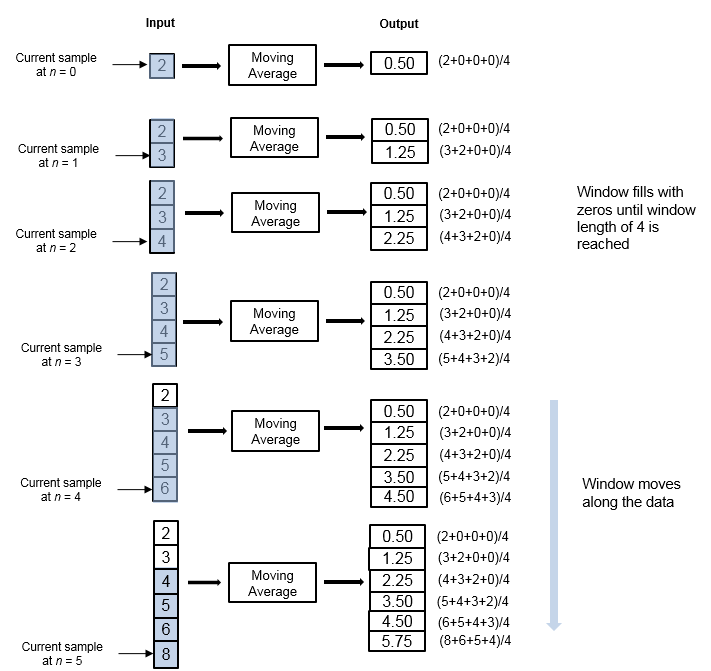 #### 1.1 สูตรหลักของ Moving Average (ค่าเฉลี่ยของ `N` ตัวล่าสุด)
ให้ `x[k]` คือ sample ล่าสุด ณ เวลา `k` และใช้หน้าต่างยาว `N`
$$
y\[k] = \frac{1}{N}\sum\_{i=0}^{N-1} x\[k-i]
$$
ตัวอย่าง (N=5):
samples = \[9.8, 9.9, 10.1, 9.7, 9.8]
average = (9.8 + 9.9 + 10.1 + 9.7 + 9.8) / 5 = 9.86
ข้อดี:
* ลด noise แบบสุ่ม
* ข้อมูลราบเรียบขึ้น
ข้อเสีย:
* มี delay (latency)
* ตอบสนองช้าลง
#### 1.1.1 สูตรด้วยตัวแปร sum
* ถ้า buffer เต็มแล้ว: ลบค่าที่จะถูกเขียนทับออกจาก `sum`
* ใส่ค่าใหม่ แล้วบวกเข้า `sum`
* ค่าเฉลี่ย = `sum / count`
เขียนเป็น LaTeX ได้แบบนี้ (เมื่อ buffer เต็มแล้ว count=N):
$$
S\[k] = S\[k−1] − x\[k−N] + x\[k]
$$
$$
y\[k] = \frac{S\[k]}{N}
$$
กรณีช่วงเริ่มต้นที่ยังไม่ครบ `N` ตัว (เหมือน `count++` ในโค้ด):
$$
y\[k] = \frac{S\[k]}{\text{count}}, \quad \text{โดยที่ } \text{count}=\min(k+1,,N)
$$
#### 1.2 Circular Buffer Visualization
```
Push: 1, 2, 3, 4, 5, 6, 7, 8, 9, 10, 11
Buffer size = 10:
After push(10): [1, 2, 3, 4, 5, 6, 7, 8, 9, 10] head=0
After push(11): [11,2, 3, 4, 5, 6, 7, 8, 9, 10] head=1
↑ overwrites oldest (1)
```
#### 1.2.1 สูตร “Circular Buffer index” (head ที่วนด้วย modulo)
ในโค้ดมีประมาณ:
$$
head←(head+1) mod N
$$
(ใช้สื่อว่า `index` วนกลับไป `0` เมื่อครบหน้าต่าง)
***
### โหลด Project Code จาก AIC Github Repo เพื่อเปิดบน VSCode IDE
{% embed url="" %}
### 2. เปิดโปรเจกต์ aic-psoc-edge-epc2-imu-filter
เปิดไฟล์ `proj_cm33_ns/sensor_hub_daq_task.c` และศึกษาโครงสร้าง:
```shellscript
aic-psoc-edge-epc2-imu-filter/
├── proj_cm33_s/ # Secure Project
├── proj_cm33_ns/
│ ├── main.c
│ ├── sensor_hub_daq_task.c
│ └── sensor_hub_daq_task.h
└── proj_cm55/ # CM55 Project
```
#### เพิ่ม Include
```c
#include /* sqrtf */
#include
```
#### **Important Macros and Variables**
```c
/*******************************************************************************
* Macros
*******************************************************************************/
#define GRAVITY_EARTH (9.80665f)
#define DEG_TO_RAD (0.01745f)
#define GYR_RANGE_DPS (2000.0f)
#define ACC_RANGE_2G (2.0f)
/* Filter Configuration */
#define FILTER_WINDOW_SIZE (10) /* 10 samples = 1 sec at 10Hz */
/* LED Macros - Active HIGH (PSoC Edge E84 USER_LED1) */
#define LED_ON() Cy_GPIO_Set(CYBSP_USER_LED1_PORT, CYBSP_USER_LED1_PIN)
#define LED_OFF() Cy_GPIO_Clr(CYBSP_USER_LED1_PORT, CYBSP_USER_LED1_PIN)
/* Custom app module ID to avoid collisions */
#define APP_RSLT_MODULE_ID (1U)
/* App error for task creation failure */
#define APP_RSLT_ACQ_TASK_CREATE_FAILED CY_RSLT_CREATE(CY_RSLT_TYPE_ERROR,\
APP_RSLT_MODULE_ID,\
1U)
/*******************************************************************************
* Motion State Enum
*******************************************************************************/
typedef enum {
MOTION_STATIONARY = 0,
MOTION_LIGHT,
MOTION_MODERATE,
MOTION_INTENSE
} motion_state_t;
/*******************************************************************************
* Moving Average Filter Structure
*******************************************************************************/
typedef struct {
float buffer[FILTER_WINDOW_SIZE];
uint32_t head; /* Position to write next */
uint32_t count; /* Current number of samples */
float sum; /* Running sum (optimized) */
} moving_avg_filter_t;
/*******************************************************************************
* Global Variables
*******************************************************************************/
static mtb_hal_i2c_t CYBSP_I2C_CONTROLLER_hal_obj;
static cy_stc_scb_i2c_context_t CYBSP_I2C_CONTROLLER_context;
static mtb_bmi270_data_t bmi270_data;
static mtb_bmi270_t bmi270;
static cy_en_scb_i2c_status_t initStatus;
static cy_rslt_t result;
/* Filter object for magnitude */
static moving_avg_filter_t mag_filter = {0};
```
#### สร้างฟังก์ชัน Raw accelerometer Conversion ชื่อ `lsb_to_mp2()`
```c
/*******************************************************************************
* Function Name: lsb_to_mps2
*******************************************************************************
* Summary:
* Converts raw accelerometer value to m/s²
*
* Parameters:
* val - raw value from sensor (-32768 to +32767)
* g_range - accelerometer range in g (2 = ±2g)
* bit_width - data width in bits (16)
*
* Return:
* float - acceleration in m/s²
******************************************************************************/
static float lsb_to_mps2(int16_t val, int8_t g_range, uint8_t bit_width)
{
float half_scale = (float)(1u << (bit_width - 1u));
return ((GRAVITY_EARTH) * val * g_range) / half_scale;
}
```
#### **สร้างฟังก์ชัน Magnitude Calcuation ชื่อ `calculate_magnitude()`**
```c
/*******************************************************************************
* Function Name: calculate_magnitude
*******************************************************************************
* Summary:
* Calculates the magnitude of acceleration vector: |acc| = sqrt(x² + y² + z²)
* Used for motion detection and impact sensing.
*
* Parameters:
* acc_x, acc_y, acc_z - acceleration components in m/s²
*
* Return:
* float - magnitude in m/s² (stationary ≈ 9.81 m/s² = 1g)
*
* Note:
* - Stationary: magnitude ≈ 9.81 m/s² (1g from gravity)
* - Moving: magnitude deviates from 9.81
* - Free fall: magnitude ≈ 0 (weightlessness)
******************************************************************************/
static float calculate_magnitude(float acc_x, float acc_y, float acc_z)
{
return sqrtf(acc_x * acc_x + acc_y * acc_y + acc_z * acc_z);
}
```
#### สร้างฟังก์ชัน Filter
```c
/*******************************************************************************
* Function Name: filter_init
*******************************************************************************
* Summary:
* Initialize the moving average filter (reset to zero)
*
* Parameters:
* filter - pointer to filter structure
******************************************************************************/
static void filter_init(moving_avg_filter_t *filter)
{
memset(filter, 0, sizeof(moving_avg_filter_t));
}
/*******************************************************************************
* Function Name: filter_update
*******************************************************************************
* Summary:
* Add new value to filter and return the current moving average.
* Uses optimized O(1) algorithm: subtract oldest, add newest.
*
* Parameters:
* filter - pointer to filter structure
* new_value - new sample to add
*
* Return:
* float - current moving average
*
* Algorithm:
* 1. Subtract oldest value from sum (if buffer full)
* 2. Add new value to buffer and sum
* 3. Update head pointer (circular wrap)
* 4. Return sum / count
******************************************************************************/
static float filter_update(moving_avg_filter_t *filter, float new_value)
{
/* Subtract oldest value from sum (if buffer is full) */
if (filter->count >= FILTER_WINDOW_SIZE)
{
filter->sum -= filter->buffer[filter->head];
}
else
{
filter->count++;
}
/* Add new value to buffer and sum */
filter->buffer[filter->head] = new_value;
filter->sum += new_value;
/* Move head pointer (wrap around) */
filter->head = (filter->head + 1) % FILTER_WINDOW_SIZE;
/* Return average */
return filter->sum / (float)filter->count;
}
```
#### **สร้างฟังก์ชัน Motion Detection ชื่อ** `detect_motion`**`()`**
```c
/*******************************************************************************
* Function Name: detect_motion
*******************************************************************************
* Summary:
* Detects motion level from acceleration magnitude
******************************************************************************/
static motion_state_t detect_motion(float magnitude)
{
float deviation = fabsf(magnitude - GRAVITY_EARTH);
if (deviation < 0.1f * GRAVITY_EARTH)
{
return MOTION_STATIONARY;
}
else if (deviation < 0.3f * GRAVITY_EARTH)
{
return MOTION_LIGHT;
}
else if (deviation < 0.6f * GRAVITY_EARTH)
{
return MOTION_MODERATE;
}
else
{
return MOTION_INTENSE;
}
}
```
#### **สร้างฟังก์ชัน Motion State Conversion ชื่อ** `get_motion_string`**`()`**
```c
/*******************************************************************************
* Function Name: get_motion_string
*******************************************************************************
* Summary:
* Converts motion state enum to display string
*
* Parameters:
* state - motion state enum value
*
* Return:
* const char* - human-readable motion state string
******************************************************************************/
static const char* get_motion_string(motion_state_t state)
{
switch (state)
{
case MOTION_STATIONARY: return "STATIONARY ";
case MOTION_LIGHT: return "LIGHT MOTION";
case MOTION_MODERATE: return "MODERATE ";
case MOTION_INTENSE: return "INTENSE! ";
default: return "UNKNOWN ";
}
}
```
### 3. เขียน Main Task Loop
```c
/*******************************************************************************
* Function Name: sensor_hub_daq_task
*******************************************************************************
* Summary:
* FreeRTOS task that reads BMI270 sensor with moving average filter
******************************************************************************/
static void sensor_hub_daq_task(void *pvParameters)
{
TickType_t xLastWakeTime = 0;
const TickType_t xDelay = 100 / portTICK_PERIOD_MS;
float acc_x = 0.0f;
float acc_y = 0.0f;
float acc_z = 0.0f;
float magnitude = 0.0f;
float filtered_magnitude = 0.0f;
motion_state_t motion_state = MOTION_STATIONARY;
(void)pvParameters;
/* Initialize I2C */
initStatus = Cy_SCB_I2C_Init(CYBSP_I2C_CONTROLLER_HW,
&CYBSP_I2C_CONTROLLER_config,
&CYBSP_I2C_CONTROLLER_context);
if (CY_SCB_I2C_SUCCESS != initStatus)
{
handle_app_error();
}
Cy_SCB_I2C_Enable(CYBSP_I2C_CONTROLLER_HW);
result = mtb_hal_i2c_setup(&CYBSP_I2C_CONTROLLER_hal_obj,
&CYBSP_I2C_CONTROLLER_hal_config,
&CYBSP_I2C_CONTROLLER_context,
NULL);
if (CY_RSLT_SUCCESS != result)
{
handle_app_error();
}
/* Initialize BMI270 */
result = mtb_bmi270_init_i2c(&bmi270,
&CYBSP_I2C_CONTROLLER_hal_obj,
MTB_BMI270_ADDRESS_DEFAULT);
if (CY_RSLT_SUCCESS != result)
{
handle_app_error();
}
result = mtb_bmi270_config_default(&bmi270);
if (CY_RSLT_SUCCESS != result)
{
handle_app_error();
}
/* Initialize filter */
filter_init(&mag_filter);
/* Clear screen */
printf("\x1b[2J\x1b[;H");
printf("************************************************************\r\n");
printf(" Lab 2-4: Moving Average Filter \r\n");
printf("************************************************************\r\n\r\n");
printf("Filter Window Size: %d samples (%.1f sec at 10Hz)\r\n\r\n",
FILTER_WINDOW_SIZE,
(float)FILTER_WINDOW_SIZE / 10.0f);
/* Initialize LED to OFF */
LED_OFF();
xLastWakeTime = xTaskGetTickCount();
for (;;)
{
/* Read sensor */
result = mtb_bmi270_read(&bmi270, &bmi270_data);
if (CY_RSLT_SUCCESS != result)
{
handle_app_error();
}
/* Convert to m/s² */
acc_x = lsb_to_mps2(bmi270_data.sensor_data.acc.x,
ACC_RANGE_2G,
bmi270.sensor.resolution);
acc_y = lsb_to_mps2(bmi270_data.sensor_data.acc.y,
ACC_RANGE_2G,
bmi270.sensor.resolution);
acc_z = lsb_to_mps2(bmi270_data.sensor_data.acc.z,
ACC_RANGE_2G,
bmi270.sensor.resolution);
/* Calculate raw magnitude */
magnitude = calculate_magnitude(acc_x, acc_y, acc_z);
/* Apply moving average filter */
filtered_magnitude = filter_update(&mag_filter, magnitude);
/* Detect motion using filtered value */
motion_state = detect_motion(filtered_magnitude);
/* Display results */
printf("Accelerometer:\r\n");
printf(" x: %9.6f m/s^2\r\n", (double)acc_x);
printf(" y: %9.6f m/s^2\r\n", (double)acc_y);
printf(" z: %9.6f m/s^2\r\n", (double)acc_z);
printf("\r\n");
printf("Magnitude: Raw=%6.3f, Filtered=%6.3f m/s^2\r\n",
(double)magnitude,
(double)filtered_magnitude);
printf("Motion: %s (deviation: %.2f g)\r\n",
get_motion_string(motion_state),
(double)(fabsf(filtered_magnitude - GRAVITY_EARTH) / GRAVITY_EARTH));
/* LED feedback - Active LOW (PSoC Edge E84) */
if (motion_state >= MOTION_MODERATE)
{
LED_ON();
}
else
{
LED_OFF();
}
/* Move cursor back for clean display */
printf("\x1b[7A");
/* Wait for UART */
while(!(Cy_SCB_UART_IsTxComplete(CYBSP_DEBUG_UART_HW))) {};
vTaskDelayUntil(&xLastWakeTime, xDelay);
}
}
```
#### Create Sensor Hub DAQ Task Function
```c
/*******************************************************************************
* Function Name: create_sensor_hub_daq_task
******************************************************************************/
cy_rslt_t create_sensor_hub_daq_task(void)
{
BaseType_t status;
status = xTaskCreate(sensor_hub_daq_task, "IMU Filter",
TASK_SENSOR_HUB_DAQ_STACK_SIZE, NULL,
TASK_SENSOR_HUB_DAQ_PRIORITY, NULL);
return (pdPASS == status) ?
CY_RSLT_SUCCESS : APP_RSLT_ACQ_TASK_CREATE_FAILED;
}
```
### 4. Build และ Flash
```bash
make build -j8
make program
```
### Output ที่คาดหวัง
```bash
Magnitude: Raw= 9.856, Filtered= 9.812 m/s²
Motion: STATIONARY (deviation: 0.00 g)
[เมื่อเขย่า - สังเกตว่า Filtered เปลี่ยนช้ากว่า Raw]
Magnitude: Raw=12.345, Filtered=10.456 m/s²
Motion: LIGHT MOTION (deviation: 0.07 g)
[หลังหยุดเขย่า - Filtered ค่อยๆ กลับสู่ปกติ]
Magnitude: Raw= 9.810, Filtered=10.123 m/s²
Motion: LIGHT MOTION (deviation: 0.03 g)
```
***
**จบ Session 2** | **ต่อไป:** Session 3: LVGL Display