# Push/Pull Button to Turn ON/OFF LED via HAL

## *Lab Objective:*

&#x20;   In this lab, participants will harness the Hardware Abstraction Layer (HAL) to interface with a push/pull button connected to the Infineon PSoC 6 microcontroller. Upon pressing the button, participants will program the microcontroller to toggle an LED's state between ON and OFF. This hands-on activity aims to familiarize participants with basic input/output operations, demonstrating real-time hardware interactions and the effective use of HAL for device control.

## 🔥 Requirements

<table><thead><tr><th width="429">Resources</th><th>Links</th></tr></thead><tbody><tr><td>Computer</td><td>💻</td></tr><tr><td>ModusToolbox™ software v3.0 or later</td><td><a href="https://www.infineon.com/modustoolbox">Link</a></td></tr><tr><td>CY8CKIT-062S2-43012 Infineon Board</td><td><a href="https://github.com/Advance-Innovation-Centre-AIC/BIIL_MTB-100_Hello_World_and_LED_Blinking_Programming_Template/assets/88732241/0215501d-b774-4045-8e64-ef49e28d8404">Link</a></td></tr><tr><td>Technical Report</td><td><a href="https://www.dropbox.com/scl/fi/amaxc94pte0ut2i1r5ewx/Technical-Report-Lab00.paper?rlkey=b3xm3vrerz9xgv1glb30cvy9z&#x26;dl=0">dropbox</a></td></tr></tbody></table>

## 🚩 Let start

### Create Application

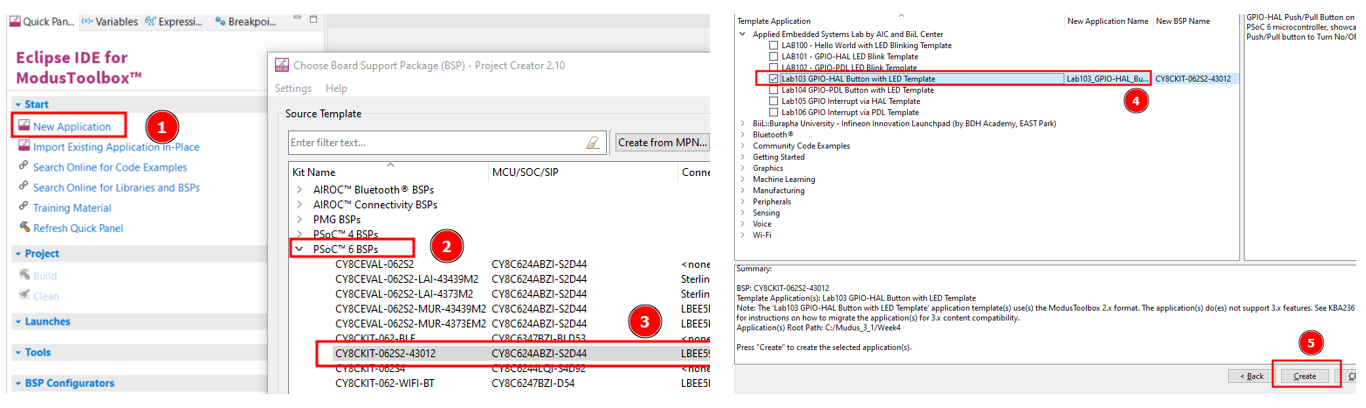
* 👉 Open Eclipse IDE ModusToolbox

<figure><img src="https://1856353139-files.gitbook.io/~/files/v0/b/gitbook-x-prod.appspot.com/o/spaces%2F-MClo3nC-1US0rbK8Qau%2Fuploads%2FD3Kfzr3p8cCmcL7Shwz0%2Fimage.png?alt=media&#x26;token=6bda2258-9b60-4c93-a9e5-325f5414bb26" alt=""><figcaption><p>Select board and Application</p></figcaption></figure>

### Hardware Abstraction Layer (HAL) API

Open Hardware Abstraction Layer (HAL) API to see the functions that use for GPIO Pin

<figure><img src="https://1856353139-files.gitbook.io/~/files/v0/b/gitbook-x-prod.appspot.com/o/spaces%2F-MClo3nC-1US0rbK8Qau%2Fuploads%2FYsAEMOc2VdoiOChJYhlb%2Fimage.png?alt=media&#x26;token=89d7dde9-f29c-4c33-9a96-cb7a5ce553d0" alt=""><figcaption><p>HAL API documentation </p></figcaption></figure>

The `HAL API` documentation provides a comprehensive set of functions to interact with the board efficiently. This API documentation offers detailed guidance on utilizing various functionalities to optimize your development process.

### Coding

* Coding: Open the main.c file and add the following code to the main(void) function.

```c
int main(void)
{
    cy_rslt_t result;

    /* Initialize the device and board peripherals */
    result = cybsp_init() ;
    /*BSP init failed. Stop program execution */
    if (result != CY_RSLT_SUCCESS)
    {
        CY_ASSERT(0);
    }
    __enable_irq();


    /* Initialize the User LED */
    cyhal_gpio_init(CYBSP_USER_LED, CYHAL_GPIO_DIR_OUTPUT, CYHAL_GPIO_DRIVE_STRONG, CYBSP_LED_STATE_ON);

    /* Initialize the user button */
    cyhal_gpio_init(CYBSP_USER_BTN, CYHAL_GPIO_DIR_INPUT, CYHAL_GPIO_DRIVE_PULLDOWN, CYBSP_BTN_OFF);

    /* Initialize retarget-io to use the debug UART port. It sets up the standard input/output functions (such as printf)*/
    cy_retarget_io_init(CYBSP_DEBUG_UART_TX, CYBSP_DEBUG_UART_RX, CY_RETARGET_IO_BAUDRATE);

    printf("\x1b[2J\x1b[;H");

    for (;;)
    {
    	//Button is active low
    	if(!cyhal_gpio_read(CYBSP_USER_BTN)){
            // Button is pressed
            cyhal_gpio_write(CYBSP_USER_LED, CYBSP_LED_STATE_ON);
            printf("Button Pressed --> LED ON \r\n");
            cyhal_system_delay_ms(250);
        }

        else {
            // Button is not pressed
            cyhal_gpio_write(CYBSP_USER_LED, CYBSP_LED_STATE_OFF);
            printf("Button not Pressed --> LED OFF \r\n");
            cyhal_system_delay_ms(250);
        }
    }
}
```

<figure><img src="https://1856353139-files.gitbook.io/~/files/v0/b/gitbook-x-prod.appspot.com/o/spaces%2F-MClo3nC-1US0rbK8Qau%2Fuploads%2Fs1q4QbGJmDgg6LbMdvm6%2Fimage.png?alt=media&#x26;token=1e1de982-b18d-453f-a18c-3723fabbb4a7" alt=""><figcaption><p>Here is the sample functions that we use from the HAL API documentation</p></figcaption></figure>

### Build the Application

* 👉 Build the Application

<figure><img src="https://1856353139-files.gitbook.io/~/files/v0/b/gitbook-x-prod.appspot.com/o/spaces%2F-MClo3nC-1US0rbK8Qau%2Fuploads%2FDCLIdY25poGI4xgZe3yh%2Fimage.png?alt=media&#x26;token=33bc7b86-7027-41c9-bdf2-cbb110fb32d5" alt="" width="491"><figcaption></figcaption></figure>

### Launching the Application

* 👉 Launching the Application

  * Before launching the program to the board, make sure that you have already connected the board to the computer through a USB cable.<br>

    <figure><img src="https://github.com/Advance-Innovation-Centre-AIC/BIIL_MTB-100_Hello_World_and_LED_Blinking_Programming_Template/assets/88732241/7a6bb6ef-cb63-4613-98a1-42f9617ad724" alt="" width="188"><figcaption><p>set up USB cable</p></figcaption></figure>
  * Launching Program

  <figure><img src="https://1856353139-files.gitbook.io/~/files/v0/b/gitbook-x-prod.appspot.com/o/spaces%2F-MClo3nC-1US0rbK8Qau%2Fuploads%2F1IuloQ1ynLW0xANdV5HN%2Fimage.png?alt=media&#x26;token=79834d7b-dcb2-4389-9da9-d8c564410e24" alt="" width="563"><figcaption></figcaption></figure>
* 👉 Check the Result&#x20;

<figure><img src="https://1856353139-files.gitbook.io/~/files/v0/b/gitbook-x-prod.appspot.com/o/spaces%2F-MClo3nC-1US0rbK8Qau%2Fuploads%2FhwmgLDAD5dx3ePlEie2x%2Fimage.png?alt=media&#x26;token=c64abe27-a23d-4b70-8e6a-35637fa71636" alt=""><figcaption></figcaption></figure>

> #### 🎉 <mark style="color:blue;">Congratulations! You can now complete Lab103</mark>

## Supported toolchains (make variable 'TOOLCHAIN')

* GNU Arm® embedded compiler v10.3.1 (`GCC_ARM`) - Default value of `TOOLCHAIN`
* Arm® compiler v6.16 (`ARM`)
* IAR C/C++ compiler v9.30.1 (`IAR`)

## Supported kits (make variable 'TARGET')

* [PSoC™ 62S2 Wi-Fi Bluetooth® pioneer kit](https://www.infineon.com/CY8CKIT-062S2-43012) (`CY8CKIT-062S2-43012`)
* [PSoC™ 62S1 Wi-Fi Bluetooth® pioneer kit](https://www.infineon.com/CYW9P62S1-43438EVB-01) (`CYW9P62S1-43438EVB-01`)
* [PSoC™ 62S1 Wi-Fi Bluetooth® pioneer kit](https://www.infineon.com/CYW9P62S1-43012EVB-01) (`CYW9P62S1-43012EVB-01`)
* [PSoC™ 62S3 Wi-Fi Bluetooth® prototyping kit](https://www.infineon.com/CY8CPROTO-062S3-4343W) (`CY8CPROTO-062S3-4343W`)

## Related resources

| Resources                       | Links                                                                                                                                                      |
| ------------------------------- | ---------------------------------------------------------------------------------------------------------------------------------------------------------- |
| ModusToolbox™ Software Training | [link](https://www.dropbox.com/sh/waj898o4o8eccx0/AAB3hBBaIQo2OvJ5-fubGJIha/training-modustoolbox-level1-getting-started-master/Manual/Ch2-Tools.pdf?dl=0) |

## Other resources

Infineon provides a wealth of data at [www.infineon.com](http://www.infineon.com) to help you select the right device, and quickly and effectively integrate it into your design.

## Document history

Document title: *BILL\_MTB-103* – *GPIO-HAL Button with LED Template*<br>

<table><thead><tr><th width="149">Version</th><th>Description of change</th></tr></thead><tbody><tr><td>1.0.0</td><td>Lab 103: Learn basic GPIO control with PSoC 6 using Push/Pull Button to Turn ON/OFF LED via HAL</td></tr></tbody></table>

## Authors:

* *Assoc. Prof. Wiroon Sriborrirux*
* *Mr. Sriengchhun Chheang*
* *Mr. Sabol Socare*<br>

<br>

***

© BDH Corporation, 2022-2023
